Did nuns really stitch them?
There are many current debates around the Bayeux Tapestry
The cost, the queues, the lack of photographic opportunities.
The more salacious discussion is the subject of penises. Apparently there are 93 of them. Once you have heard that number, it is quite hard to look at the embroidery in the same way again.
The count comes from historian George Garnett: 88 belong to horses and five to men. So this is less a parade of naked Normans than a reminder that the embroiderers paid close attention to their horses. The famous “tapestry” is, of course wool embroidered on linen, rather than a woven tapestry. I shall keep calling it a tapestry, as everyone else does, but the stitches matter to this story.
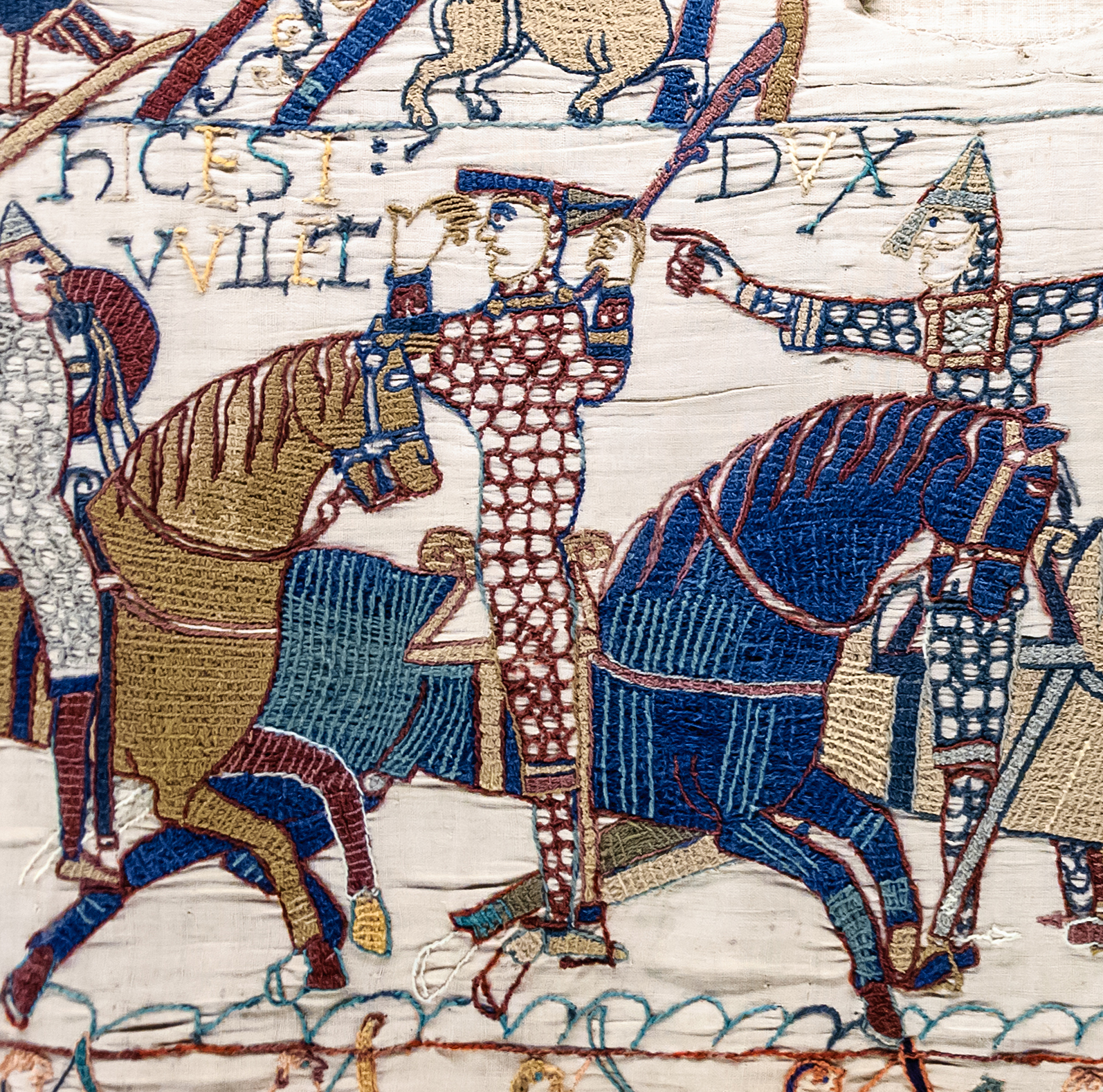
Is 93 the final answer?
Probably not. Christopher Monk thinks Garnett missed one on a little club-carrying figure running through the lower border: 94, then. Garnett sees a scabbard. Part of the detail has been restored, which makes a confident verdict even harder. The two historians are looking closely at the same stitches and disagreeing about what they show. That is a more useful history lesson than a neat total.
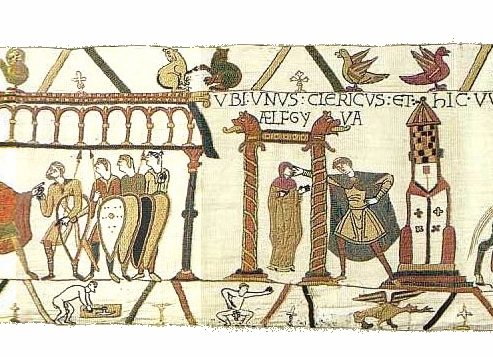
Look beneath the grand procession and the borders become a world of their own: animals, fables, odd little people and flashes of nakedness. Monk reads some of the exposed bodies as a comment on the swagger and aggression in the story above. Garnett has suggested that the conspicuous anatomy of certain horses may speak to status and masculine power. Those are interpretations, not labels left by the eleventh-century makers. I like the idea that the margins might be talking back to the kings, but I would not claim to know what every stitch meant.
But did nuns create it?
We do not know the names of the people who designed or embroidered it. The romantic tale of Queen Matilda sewing with her ladies is just that: a tale. Nuns are often suggested, but there is no document placing this work in a convent. Embroidery specialist Alexandra Lester-Makin finds evidence in the work itself of trained hands and careful organisation, perhaps a professional workshop. Women almost certainly had a major part in making it; exactly who devised the images, and how much freedom the stitchers had, remains open.
And the question I keep hearing is: had nuns ever seen a penis? Well, a vow of celibacy is not a vow of ignorance. Some women entered religious life after marriage; horses, for one thing, were not shy about their anatomy. More to the point, we cannot infer the artists’ life experience from a cartoonish picture of the medieval nun as a sheltered child. Nor can we decide that a woman could only embroider these details if a man drew them first. Perhaps a designer supplied a pattern. Perhaps a stitcher added a flourish. We do not have the evidence to identify the hand behind a particular joke.
There is a delicious reversal in the later history. When 35 women of the Leek Embroidery Society made the Reading replica in the 1880s, the source photographs had already been tidied up by the South Kensington Museum. The Victorian embroiderers copied what they had been given. The original medieval border was franker than the nineteenth-century version.
So yes, 93 is a real scholar’s count, with a lively case for 94. But the number is only the beginning. The more interesting question is whose voice we hear in those margins: the patron who wanted a conquest story, the person who drew it, or the skilled people who spent hour after hour giving it life in thread. We may never know. We can at least stop assuming the last of them had nothing interesting to say.
If you want to go looking for yourself, the Bayeux Museum’s online explorer is a wonderful place to start. Fair warning: you may be there a while.


