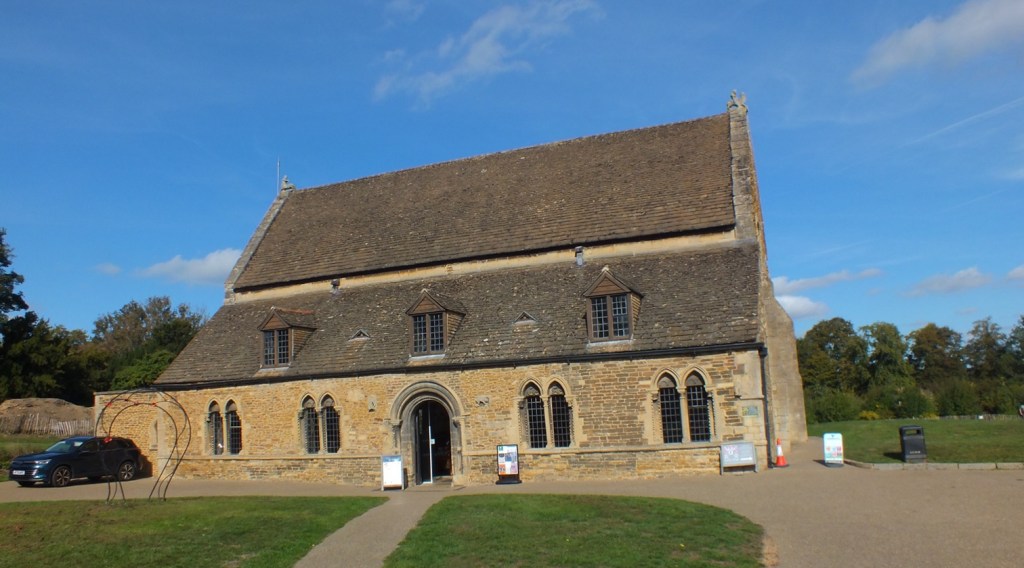
Oakham Castle great hall. Photograph: Baz Aveyard.
I went to Oakham Castle with Margaret de Clare in mind. She was Piers Gaveston’s wife, Edward II’s niece, and a woman whose life continued through the dangerous years after Piers was killed. The great hall in my photograph was already old when she received the castle. Its long roof and doorway have survived; the rest of her world takes a little more work to recover.
Edward granted Oakham to Margaret in September 1312, three months after Piers’s death. That gift was part of a longer story. Margaret would marry another of the king’s favourites, Hugh Audley, and Oakham would follow them through the changing politics of Edward’s reign. It is a useful place from which to see the people around Piers as individuals, with futures of their own.
The hall and the wider castle
What survives at Oakham is the great hall, built for Walkelin de Ferrers in the late twelfth century. The word “castle” once meant much more than this one building. The hall stood within a walled enclosure, with a mound, other buildings, a garden and fishponds. It was a place of lordship and administration as well as a residence. A later account, made in 1340, describes a hall, chambers, chapel, kitchen, stables, prison, forester’s house, gatekeeper’s lodge and drawbridge. Much has disappeared, but the hall gives us something unusually tangible: a room in which medieval business could actually have been conducted.
Inside are Oakham’s famous ceremonial horseshoes, left by visiting peers. They make a memorable display, though the oldest surviving shoe dates from Edward IV’s visit in 1470, long after Margaret’s time. For her part in the story, the royal records are our guide.
Two Margarets, one title
The story becomes confusing because two women called Margaret de Clare were countesses of Cornwall at almost the same time. The older Margaret had been married to Edmund, earl of Cornwall. Their marriage had ended years before his death in 1300, but she held estates provided for her, including Oakham. A royal order of February 1301 directed that the castle be delivered to her. She was still alive throughout Piers Gaveston’s brief career as earl of Cornwall.
The younger Margaret was her niece. She was also Edward II’s niece, the daughter of Joan of Acre, Edward I’s daughter, and Gilbert de Clare, earl of Gloucester. Edward arranged her marriage to Piers in 1307. It joined his favourite to the royal and Clare families. The older Margaret still held Oakham during Piers’s lifetime. I mention this because the shared name and title can easily obscure the younger woman’s own history here.
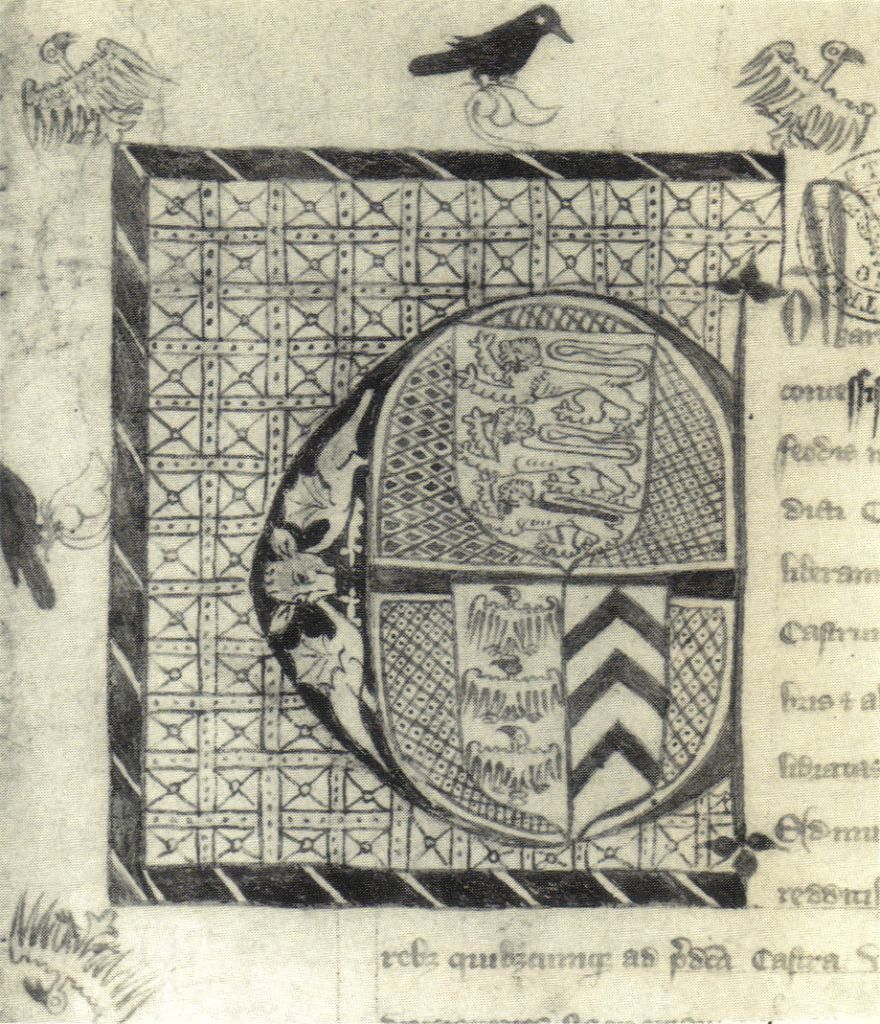
An image from Edward’s charter making Piers earl of Cornwall gives the story a striking visual trace. The illuminated initial displays Edward’s arms above those of Gaveston and de Clare. The charter, dated 6 August 1307, also promised Piers the Rutland property held by the older Margaret once she died. Margaret and Piers did not marry until November. The arms suggest that their union was already envisaged, while the words of the grant make the timing clear: Piers had a future claim, not possession of Oakham during her lifetime. He died before she did.
June to September 1312
Piers was captured after surrendering Scarborough Castle and was taken into the hands of men hostile to him. On 19 June 1312 he was killed on Blacklow Hill near Warwick. Edward had lost the man he had raised so rapidly and defended so stubbornly. Margaret had lost her husband; their daughter Joan was still an infant. The political argument over Piers did not end with his death. Margaret needed lands and income, and there were difficult questions over what she could claim from the earldom of Cornwall.
Then the older Margaret died. On 20 September 1312, recording a grant dated 16 September, the patent rolls name “Margaret, late the wife of Peter de Gaveston” and grant her Oakham Castle and other property. The terms say that she was to hold it during the king’s pleasure for her sustenance, until he made other provision. A further grant in October dealt with the associated rights, including knights’ fees and church patronage. The wording matters. It places the younger Margaret here as Gaveston’s widow and makes the king’s practical provision for her explicit.
The grant establishes Margaret’s legal connection to Oakham. Whether she stayed in this hall is a different question, one the grant cannot answer. It is still possible to stand here and think about what the provision meant to her: a named place and an income in the months after Piers’s death.
A second royal favourite
Margaret married again on 28 April 1317. Her second husband, Hugh Audley, was a knight of Edward II’s household and one of the men enjoying the king’s particular favour. Edward had first married his niece to Piers; he now saw her married to another favourite. For Margaret, these were two distinct marriages, each drawing her into the centre of royal politics in a different way. Hugh deserves more than a passing mention as “the man after Gaveston”.
Oakham was granted to Margaret and Hugh together, and a settlement in July 1319 confirmed that they could hold it for their lives. The patent roll explains the arrangement in terms of Margaret’s still unresolved dower from Piers’s lands. Her first marriage remained part of the legal language of her second. The castle links the two chapters of her life without making them the same story.
The politics of Edward’s reign caught up with the Audleys. Hugh opposed the king in the troubles of 1321–22; in July 1322 Oakham was granted to Edward’s half-brother Edmund, earl of Kent. After Edward II fell, Hugh and Margaret recovered their position. In 1327 the record again concerns the return of Oakham. This was not a static estate quietly passing from one name to another. Its custody followed rebellion, forfeiture and a change of king.
A glimpse of the book
Standing before the hall, I think of the two Margarets, both countesses of Cornwall, and the single castle that passed between their lifetimes. Then I think of Margaret and Hugh, who held Oakham together only to be pulled into the next political crisis. The building in my photograph is older than all of them, but the records give it a place in their changing lives.
I am following Piers Gaveston’s world for a forthcoming book. Oakham offers a small glimpse of one thread: what happened to the people closest to him after Blacklow Hill. Margaret’s story did not end with his, and it may be one of the best ways to understand what his death left behind.
Sources and further reading
Edward II’s charter for Piers Gaveston, 6 August 1307, The National Archives, E 41/460; illuminated initial reproduced via Wikimedia Commons (public domain): read source.
Calendar of Patent Rolls, Edward II, grants of 20 September and 7 October 1312; 20 July 1319: read source.
Historic England, Oakham motte and bailey castle and medieval gardens, list entry 1010702: read source.
Historic England, Oakham Castle great hall, list entry 1073277: read source.
Oakham Castle, history and horseshoe collection: read source.
University of Bristol research on Margaret de Clare and Hugh Audley: read source.


Leave a Reply