25 October 2026 · By Barry Aveyard — The Medieval History Bloke
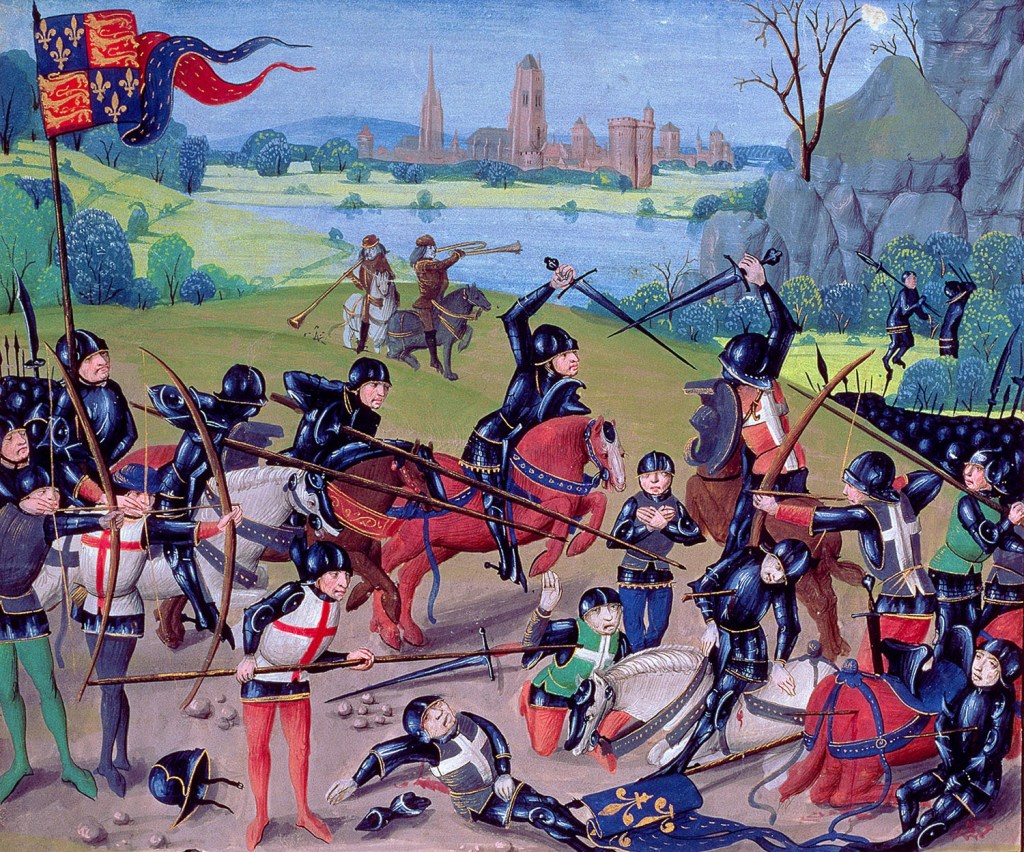
St Albans Chronicle, associated with Thomas Walsingham, Lambeth Palace Library, MS 6, fol. 243.
Today, on St Crispin’s Day, we mark 611 years since the Battle of Agincourt, fought on 25 October 1415. Few medieval battles have secured such a lasting place in the imagination. Henry V, the longbowmen and a muddy French field have become part of a story told and retold for centuries.
For me, the anniversary also raises a question: what happens when we follow the story beyond the battlefield, into the lives of those who had to live with its consequences?
That question leads towards Catherine de Valois, the subject of one of my forthcoming books.
Henry’s campaign had begun with the siege of Harfleur. Although the town surrendered, the expedition had taken a heavy toll. Disease weakened the army, and the march towards English-held Calais became increasingly difficult as French forces obstructed its route. Supplies dwindled. Before Agincourt became a celebrated victory, Henry’s men faced the very real possibility of disaster.[1]
Rain had turned the ground to mud. Henry’s archers used defensive stakes, and their arrows helped disrupt the French attack. Advancing across the sodden battlefield was exhausting; when the armies closed, the fighting was fierce. The victory emerged from weapons, decisions and conditions on the ground, with men fighting for their lives.[2]
It is easy, looking backwards, to treat the outcome as inevitable. It cannot have felt that way to the men waiting to fight.
Shakespeare later gave Agincourt its most enduring literary voice. His St Crispin’s Day speech has helped generations imagine Henry inspiring his army. It is magnificent theatre, written long after the battle. We should enjoy it while remembering that it cannot tell us precisely what Henry said that morning.
Nor should the stirring language drown out the losses. Behind every casualty was a household facing an absence. A battlefield victory could bring celebration to one community and years of grief to another. Those consequences matter when we try to understand medieval lives.
Agincourt also left the struggle for France unresolved. Five years later, the Treaty of Troyes recognised Henry as heir to Charles VI of France, and Henry married Charles’s daughter, Catherine de Valois. The marriage placed Catherine at the centre of an ambitious dynastic settlement.[3]
This is where my interest as a biographer deepens. Catherine can disappear behind the reputation of her husband, introduced chiefly as the princess he married. Yet her life deserves sustained attention in its own right.
She became queen of England and mother of the future Henry VI. When Henry V died in 1422, she was a young widow with an infant son. Her later relationship with Owen Tudor brought another dynasty into the story: their son Edmund would become the father of Henry VII.[4]
Catherine’s life connects the Valois, Lancastrian and Tudor families. Following her story takes us from royal marriage negotiations to widowhood, motherhood and the uncertainties surrounding her later union. It also demands care over what the surviving evidence allows us to say.
That is part of what draws me to writing about her. I want readers to encounter Catherine as a woman whose life is worth exploring, with all the difficulties of recovering a person so often viewed through the men around her.
On this anniversary, there is room to remember the achievement of Henry’s army and to reflect on the suffering that accompanied it. There is also room to ask whose stories remain outside the familiar account.
For me, Catherine is one of those people. Agincourt is a compelling place to begin; her life gives us reason to keep reading.
Find out more about my forthcoming Catherine de Valois biography and my other books:
https://themedievalhistorybloke.co.uk/books/
Sources:
[1] College of Arms, “The Battle of Agincourt”: https://www.college-of-arms.gov.uk/news-grants/news/item/119-the-battle-of-agincourt
[2] Musée de l’Armée, “The battle of Agincourt”: https://www.musee-armee.fr/ExpoChevaliersBombardes/battle-agincourt.html
[3] English Heritage, “Consorts and their connections to English Heritage sites”: https://www.english-heritage.org.uk/visit/inspire-me/consorts-and-their-connections-to-english-heritage-sites/
[4] Westminster Abbey, “Henry V and Catherine de Valois”: https://www.westminster-abbey.org/abbey-commemorations/royals/henry-v-and-catherine-de-valois


Leave a Reply